Online Interview with Bloomsbury

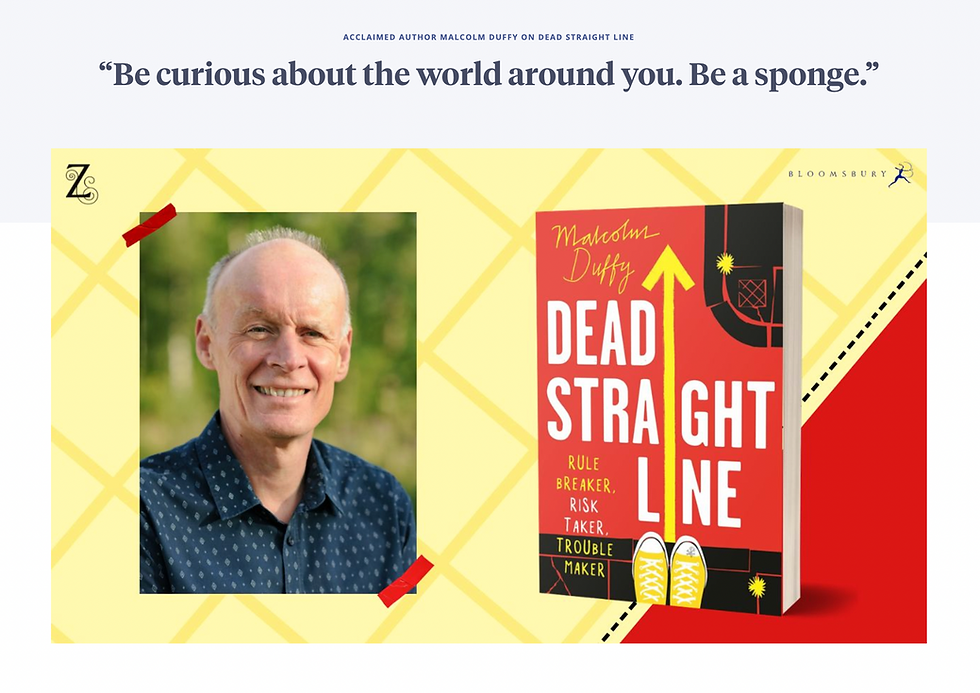
Praised by the School Reading List as 'the best YA novel [...] of the past ten years', Dead Straight Line is a gripping contemporary drama where a risk taken on one fateful night changes two teenagers' lives forever. We sat down with Malcolm Duffy to learn more about how he built the cast of this tautly stretched narrative, and what he hopes readers take away from it.
At one point, the protagonist Rory thinks to himself, ‘Risk is the snake that bites when you least expect it.’ What made you want to write this story of risk and consequence? Why was the game Dead Straight Line the best medium for this?
I’m fascinated by the subject of risk. Why do we take risks, and why do ignore the possible consequences when things go wrong? I thought of all the risky things teenage boys could do, but I wanted something unusual, that would stand out from the crowd. I remembered a crazy game I played as a teenager – ignoring paths, and roads, and heading home with a friend in a dead straight line. It was the perfect game for Rory and his friends to play.
You don’t physically describe Rory in the book – how did you want this to impact the reading experience? Whom do you see in your mind’s eye when you imagine him?
I like readers to imagine their own version of Rory. I think as a writer what you leave out can be as important as what you put in. If I were to picture him as a real person, it would be a 16-year-old Harry Styles: someone who’s tall, fit, good-looking, charismatic, funny, with a devil-may-care attitude.
The book feels like it’s in conversation with the coiled anger and conflict a lot of young people carry within them during their teen years. Do you remember the first time a book made you feel seen?
YA novels weren’t really a thing when I was reading in my teens, but the first book I read that touched a nerve was The Catcher in the Rye, with the angst-ridden, disillusioned Holden Caulfield.
The book is pacey and immediate, with a narrative style that keeps you in the present and the storyline moving; did you experiment with different voices and approaches when creating Rory’s inner monologue?
When writing Rory’s character, the thing I liked to focus on was the situation. How does he react to each different circumstance in which he finds himself? Will the situation make him feel happy, sad, lonely, lost, angry, confused? I try not to involve my own feelings, but I sometimes ask the question – what would I do/feel in that situation? That’s what gives me Rory’s voice.
Friendships at this age can feel lifelong one day and then dissolve the next – Rory takes a few hits in this vein from members of the gang. Tell us about the process of building out the teenage cast of characters around him.
I decided to create a small group of key characters who impact Rory’s life. Too many and it might get confusing. Too few, and it may feel like Rory isn’t as charismatic as he thinks he is. I painted a brief picture of each of the gang members, because they are absent from Rory’s life for most of this story. They needed to be memorable, but not so huge that they’d detract from Rory. Lauren and Eden took longer to develop, as they play a key part in Rory’s efforts to rebuild his life. I thought about my own daughters (now aged 18 and 22), and how they behaved when they were younger.
I feel there is so much out there already about the dangers of social media, and yet young adults still take risks that aren’t attributable to smart phones.
Early on in the story, a young man’s life is changed forever by a game of Dead Straight Line. What led you to develop Eliot’s character and this portrayal of paraplegia?
I thought long and hard about what should happen to Eliot. I even toyed with the idea that he might die, but was persuaded not to. It’s far better if both Eliot and Rory have to live with the long-term effects of what has happened. My mum was wheelchair-bound for the last few years of her life, and I discovered many of the issues faced by those who can no longer walk. I also spoke to David Eastham at the Spinal Injuries Association. David lost the use of his legs as a young man when he was in a scooter accident in Thailand. As a result of my conversations, I wanted to show the positive side of paraplegia. That you can lead a long and fulfilling life despite the constraints of being in a wheelchair.
Rory and the wry Falklands war veteran Tanker find things they have in common despite their generation gap: partly what Tanker calls ‘demons swimming lengths’ in their heads. What inspired this unlikely mentor and his specific background?
I’d spent several years working for the charity Combat Stress, which helps veterans with PTSD, and felt it would be good for Rory to meet someone who’s had to deal with far more problems than the one he faces. As I’m from Newcastle, I decided to give Tanker a Geordie accent. I like the juxtaposition of different accents and different backgrounds. It adds a fresh dimension to the story.
While social media exists in the book (with its accompanying dangers), you’ve chosen to have the vast majority of interactions take place in person, through tense encounters between Rory and other players. Was there a reason you kept the plot largely offline in a digital world?
I deliberately set the story in the non-phone world. I feel there is so much out there already about the dangers of social media, and yet young adults still take risks that aren’t attributable to smart phones. The toxicity of social media is touched upon, but I didn’t want it to overwhelm. I like relationship dramas that aren’t driven by smart phones.
You explore ideas of guilt and innocence at length; what do you want readers to take away from reading this story where different accounts of the same event can have such dire consequences?
People often react completely differently to the same event. While some can forgive, others will strive for revenge. I like my stories to reflect the way individuals behave. Good people can do bad things. Bad people can do good things. I like readers to make their own minds up as to who they feel is guilty, who is innocent, and who deserves forgiveness.
We get the sense at the end of the book that Rory is beginning to find his own voice as a storyteller and speaker. What advice do you have for young people who want to tell their own stories?
The best advice I can give to young writers is to be curious about the world around them. Be a sponge. Don’t have a blinkered view of what’s happening around you. Soak up everything: news, accents, behaviour, stories, attitudes, comments, fashion, music. All of my stories are born out of my own experiences. You can do the same.

Comments